 English EN
  Indonesia ID

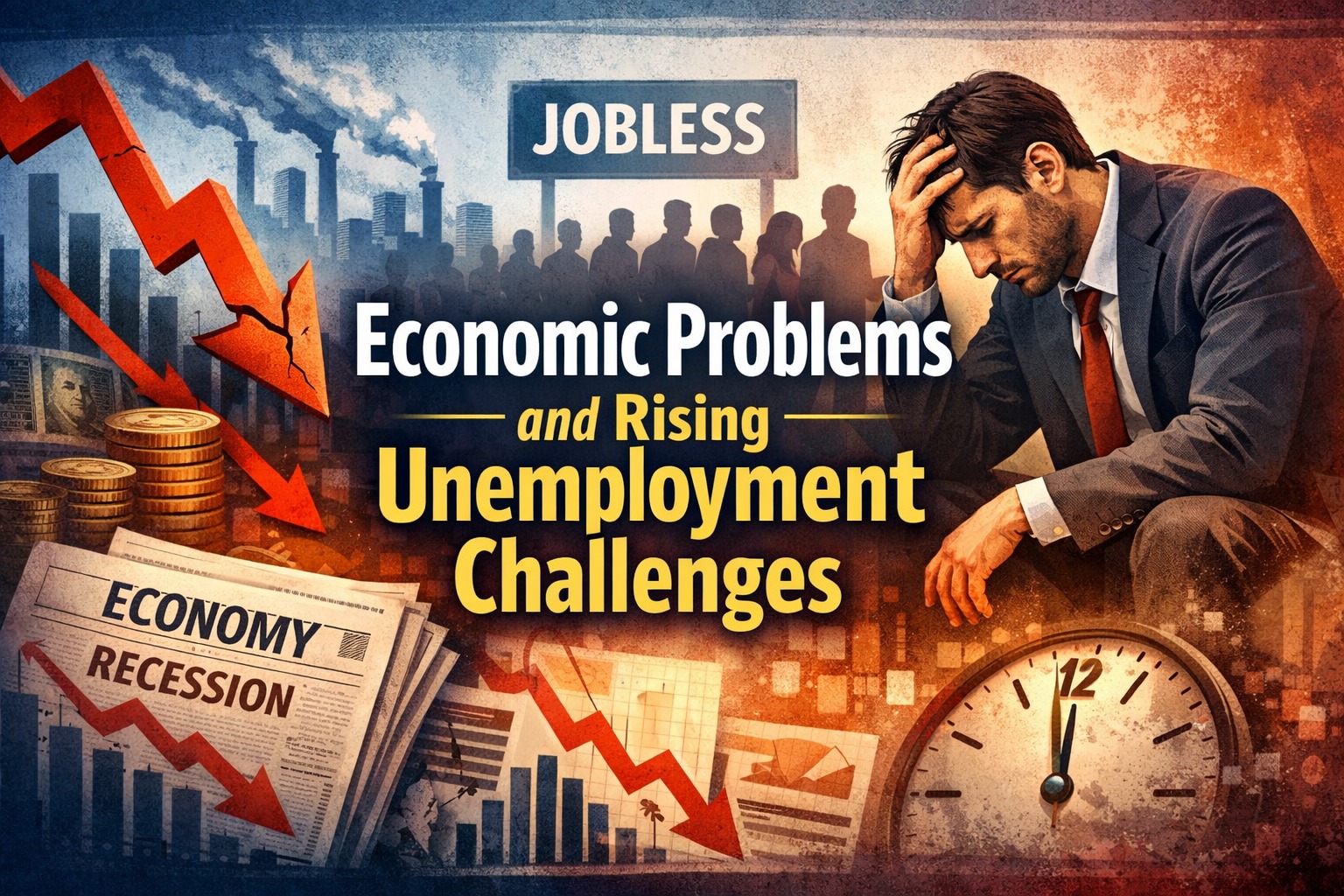
Economic problems and rising unemployment have become major concerns in many countries around the world. Economic instability not only affects businesses and governments, but also directly impacts the lives of ordinary people. When unemployment rates increase, people struggle to meet their daily needs, while companies face declining productivity and consumer demand. These conditions create a chain reaction that can weaken a nation’s economy over time.
In recent years, global economic uncertainty, inflation, technological changes, and business competition have intensified unemployment challenges. Therefore, understanding the causes, impacts, and possible solutions to unemployment is essential for creating sustainable economic growth and social stability.
CAUSES OF ECONOMIC PROBLEMS AND UNEMPLOYMENT
Several factors contribute to economic problems and rising unemployment. One major cause is economic recession, where business activities slow down and companies reduce their workforce to cut operational costs. During difficult financial periods, many industries experience declining sales, forcing employers to terminate employees or freeze recruitment.
Another important factor is technological advancement and automation. While technology improves efficiency, it also replaces many traditional jobs. Workers who lack modern skills often find it difficult to compete in the labor market. As industries adopt digital systems and artificial intelligence, demand for low-skilled labor continues to decrease.
Globalization also affects employment opportunities. Many companies relocate factories or outsource services to countries with lower labor costs. This situation creates job losses in regions where production expenses are higher. Additionally, population growth without sufficient job creation increases competition among job seekers.
IMPACTS OF RISING UNEMPLOYMENT
Rising unemployment can create serious economic and social consequences. Financially, unemployed individuals often experience income loss, making it difficult to pay for housing, education, healthcare, and basic necessities. This condition may increase poverty levels and reduce overall consumer spending.
From a social perspective, unemployment can lead to stress, depression, and reduced self-confidence. Long-term unemployment may also increase crime rates and social inequality. Communities with limited job opportunities often experience instability and declining quality of life.
For governments, high unemployment reduces tax revenue while increasing public spending on social assistance programs. Economic growth slows because fewer people contribute to production and consumption activities. As a result, national development becomes more difficult to achieve.
STRATEGIES TO OVERCOME UNEMPLOYMENT CHALLENGES
Addressing unemployment requires cooperation between governments, businesses, and educational institutions. One effective strategy is improving education and vocational training programs. Workers need practical skills that match current industry demands, especially in technology, digital business, and creative sectors.
Governments can also encourage economic growth by supporting small and medium-sized enterprises (SMEs). These businesses create employment opportunities and strengthen local economies. Providing financial support, tax incentives, and entrepreneurship training can help more people start their own businesses.
Investment in infrastructure projects is another important solution. Large-scale development projects can generate thousands of jobs while improving transportation, communication, and public facilities. Additionally, policies that promote innovation and sustainable industries can create long-term employment opportunities.
CONCLUSION
Economic problems and rising unemployment challenges continue to affect societies across the globe. Factors such as recession, automation, globalization, and limited job opportunities contribute to increasing unemployment rates. The impacts are not only economic but also social and psychological.
To reduce unemployment, countries must invest in education, workforce development, entrepreneurship, and sustainable economic policies. By creating more inclusive opportunities and adapting to changing economic conditions, societies can build stronger economies and improve the quality of life for future generations.