 English EN
  Indonesia ID

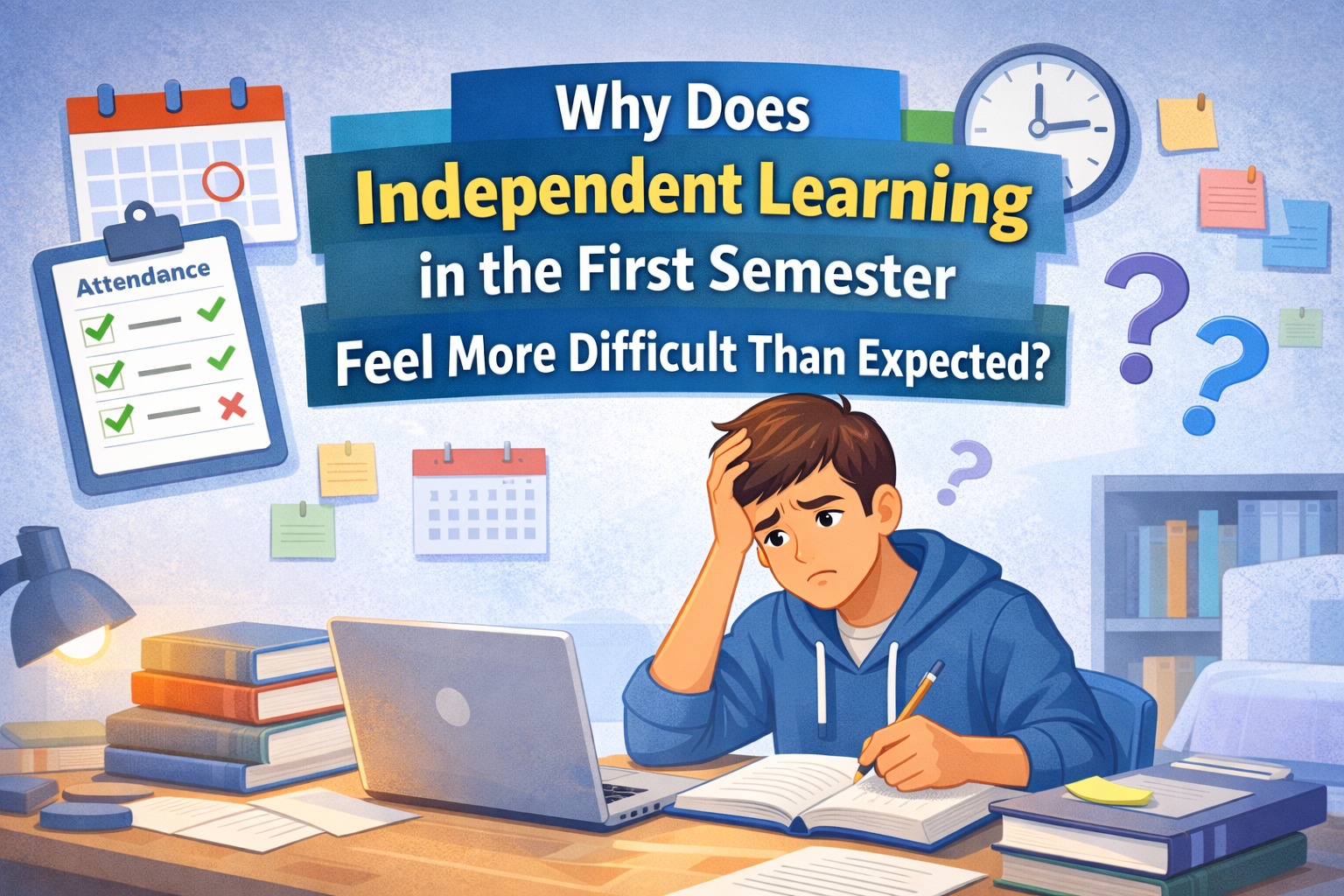
Entering university is often imagined as a more relaxed phase compared to school life. There are no uniforms, schedules seem more flexible, and lecturers do not always check assignments daily. However, in reality, many first-year students feel overwhelmed. The independent learning system that characterizes higher education turns out to have challenges that are rarely discussed openly.
This article explores why independent learning in the first semester feels harder than expected and provides an overview of solutions that new students can apply.
A Drastic Change in the Learning System
In school, students are accustomed to a structured learning system. Teachers remind them of assignments, explain materials in detail, and follow relatively fixed schedules. Upon entering university, this pattern changes completely.
Students are expected to understand materials independently through modules, journals, or additional references. Lecturers usually provide only a general overview, while deeper understanding becomes the student’s personal responsibility. This drastic change often shocks new students who are not yet used to managing their own learning process.
No One Is Constantly Monitoring Anymore
One of the biggest challenges of independent learning is the lack of direct supervision. There is no homeroom teacher checking homework, and lecturers do not always reprimand students who are less active.
This situation demands strong self-discipline. For students who were previously motivated mainly by external pressure, this condition can lead to procrastination, inconsistent study habits, and eventually feeling overwhelmed before exams.
Underdeveloped Time Management Skills
Many first-semester students do not yet have strong time management skills. A less crowded class schedule is often mistaken for free time, even though it should be used for reading materials, completing assignments, or engaging in discussions.
As a result, tasks pile up near deadlines. Studying becomes rushed and ineffective. This is why independent learning feels difficult—not necessarily because the material is always hard, but because time management is still ineffective.
A Larger and Deeper Volume of Material
University learning requires deeper understanding than school. Reading materials are more extensive, academic terms are more complex, and class discussions demand critical thinking.
New students are often unprepared for this level of cognitive load. Without quickly adapting effective study methods—such as summarizing or active reading—the material feels overwhelming and difficult to understand.
Feeling Shy or Afraid to Ask Questions
In an independent learning system, the ability to ask questions is essential. Unfortunately, many new students hesitate to ask lecturers or peers because they fear being seen as less capable.
Without asking questions, confusion continues to accumulate. Independent learning does not mean studying alone without help, but actively seeking understanding through various sources, including discussion.
A New Environment Full of Distractions
Campus life offers freedom and many new activities: student organizations, friendships, campus events, and digital entertainment. Without good self-control, academic focus can easily be disrupted.
First-semester students are often still in a phase of social exploration, causing academic priorities to be neglected. When study time decreases, independent learning feels even more difficult.
Not Yet Finding the Right Learning Style
Everyone has different learning styles—visual, auditory, or kinesthetic. In the early semester, many students have not yet discovered the most effective way for them to learn.
Without the right strategy, studying becomes longer and more exhausting. This makes independent learning feel heavy, even though the issue lies in the method, not ability.
How to Overcome Independent Learning Challenges
To avoid feeling overwhelmed, new students can start with simple steps:
- Creating a realistic weekly study schedule
- Breaking large tasks into smaller parts
- Actively asking questions when confused
- Forming study groups
- Reducing distractions during study time
Independent learning is a skill that develops over time. The more it is practiced, the more comfortable students become.
Conclusion
Independent learning in the first semester feels difficult not because students are incapable, but because of changes in the learning system, increased personal responsibility, and limited readiness in time management and study strategies. These challenges are experienced by almost all new students.
The good news is that independent learning skills can be trained. With discipline, the right strategies, and the courage to seek help, students can adapt and turn this system into a valuable foundation for academic and career success.